 📍 Campsite
Pinon Flats Campground
Campsite · Mosca, Colorado
About this stopover
National Park Service campground, 90 sites
Overview
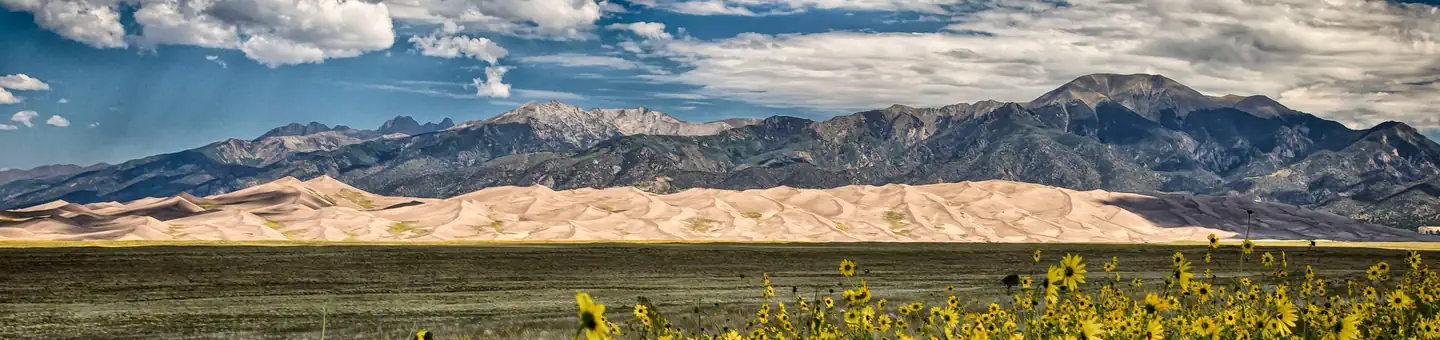
Great Sand Dunes National Park and Preserve is in the San Luis Valley of south-central Colorado at an elevation of 8,175 feet. The dunes lie on the eastern edge of the valley at the base of the Sangre de Cristo Range. The dunefield is part of the nearly 150,000 total acres of the park and preserve that also protects alpine lakes, tundra, six peaks over 13,000 feet, ancient spruce and pine forests, large stands of aspen and cottonwood, grasslands, and wetlands. The park is part of a fragile, dynamic system that influences and sustains the tallest dunes in North America.
President Herbert Hoover established the park unit as a national monument by presidential proclamation on March 17, 1932 through the Antiquities Act. The Works Progress Administration constructed the Superintendent’s Residence, now listed on the National Register of Historic Places. But otherwise, GRSA did not see a great deal of development during the New Deal. Park development did not occur in earnest until Mission 66.
During this period, the NPS was able to construct a Visitor Center, the Pinon Flat Campground (88 sites), a picnic area, five comfort stations, six single family residences and a triplex, while also building or improving roads and trails through the park. The Visitor Center shows the motivation of the Western Office of Design and Construction to configure designs to corresponding regions using principles of “regional modernism.” Built in the Pueblo Revival style, the Visitor Center mimics adobe construction through modern materials and forms blended with traditional materials and forms seen during the CCC-era in Cecil Doty’s work.
Following Mission 66, Congress designated nearly 91% of the monument as wilderness in 1976, which certainly limited the park’s ability to further develop visitor and administrative facilities. GRSA became a national park and preserve in 2000, which also included a transfer of land from the Rio Grande National Forest.
The dunes have long stood as a landmark for travelers from ancient North Americans to Southern Ute, Jicarilla Apaches, Navajos, early explorers, gold miners, homesteaders, ranchers, farmers and migrant field workers, to you - today's park visitor.
Recreation
Great Sand Dunes' wide range of natural features provides endless outdoor recreational activities. The park is perfect for kids, who love exploring the dunefield on foot or by sled. Medano Creek, at the base of the dunes, is a popular place in the summertime. Kids and adults alike love to splash in the cool water.Many kid-friendly, ranger-led activities and a junior ranger program are available.
Many miles of hiking and backpacking trails lead through the park's forests and alpine terrain, including the Mosca Pass Trail, Dunes Overlook/Sand Ramp Trail and Indian Grove Trail.
Facilities
Reservations are required to stay in Pinon Flats campground. The campground offers 88 campsites. The park recommends making a reservation in advance, especially for peak summer months from May through September. Private first-come, first-served camping is also available just outside the park boundary. For more information about camping, visit www.nps.gov/grsa/planyourvisit/camping.htm.
Due to the historic design, the campground may not be able to accommodate all large, modern size vehicles. Most sites are small and unlevel, review photos and measurements carefully when choosing a site.
During visitor center operating hours, you can see a park film, experience interactive exhibits, speak with a helpful ranger and visit the Western National Parks Association store. Kids of all ages can pick up a Junior Ranger booklet or participate in the Junior Ranger Explorer program.
Natural Features
Great Sand Dunes are the magnificent centerpiece of a natural system that includes high mountain peaks, sparkling streams, vast grasslands and lush forests.The campground is situated among pinon pines and sagebrush beneath the majestic Sangre de Cristo Mountains. Most sites have beautiful views of the snow-covered peaks.
A wide variety of grasses and wildflowers can be found throughout the area, and mule deer are commonly seen in and around the campground.
Nearby Attractions
Zapata Falls is just south of the national park off Highway 150. A short but slippery 1/2-mile hike leads to a 25-foot high cascade. Simply driving to the trailhead provides an excellent view of the entire dunefield and San Luis Valley, especially at sunrise or sunset. San Luis State Wildlife Area is located at the western edge of Great Sand Dunes National Park. It features a large natural lake popular for boating, water skiing, sailing, windsurfing and fishing.Charges & Cancellations
This is not a staffed facility.
Campground hosts may be available for assistance. Visitors are responsible for knowing their site number and proceeding to the correct site after 2:00 PM. Early check in is not available.
A no-show visitor is one who does not arrive at the campground during their reservation, and does not cancel their reservation. Because this is an unstaffed location, the site will be held for the duration of the reservation and the visitor will not receive a refund for time not spent in the site. Due to the limited number of sites in Pinon Flats Campground, please cancel or change your reservation if you can not use it, so other campers have an opportunity to stay.
Location
Reviews (0)
Nearby places
Browse Colorado →
Opens Recreation.gov in a new tab. They take the booking, not us, and we earn nothing on it.
Data source: Recreation.gov View on the source site Information last updated 11 March 2026