Last reviewed: 12 November 2026
Aires are designated motorhome stopping places in France, run by local municipalities, campsites or private businesses. They offer anywhere from a simple overnight parking bay to full hook-up pitches with electricity, fresh water and waste disposal. Many are completely free, though a growing number charge a small fee, typically between €5 and €20 per night depending on the services on offer.
Quick facts
- France has thousands of aires across the country, from rural villages to coastal towns
- Free aires (aires de service gratuites) offer parking only or basic services at no charge
- Paid aires typically cost €5 to €20 per night; services like electricity and water may cost extra via tokens or cards
- Service points (aires de service) for emptying cassettes and filling fresh water are often separate from overnight pitches
- The legal maximum stay at most aires is 24 to 48 hours unless otherwise posted
- Aires are specifically for motorhomes and campervans; caravans and tents are not permitted
What exactly is an aire in France?
An aire (pronounced "air") is a purpose-built stopping place for motorhomes and campervans. The word is short for aire de camping-car, and you'll see that phrase on road signs throughout France. They're the French equivalent of a Stellplatz in Germany or an area di sosta in Italy, though France has arguably the most developed network of the three.
Local councils created the system partly to encourage motorhome tourism into smaller towns and villages that wouldn't otherwise have any visitor accommodation. The idea works well for everyone: motorhomers get a safe, legal place to stop, and the village gets visitors spending money in the boulangerie and the café.
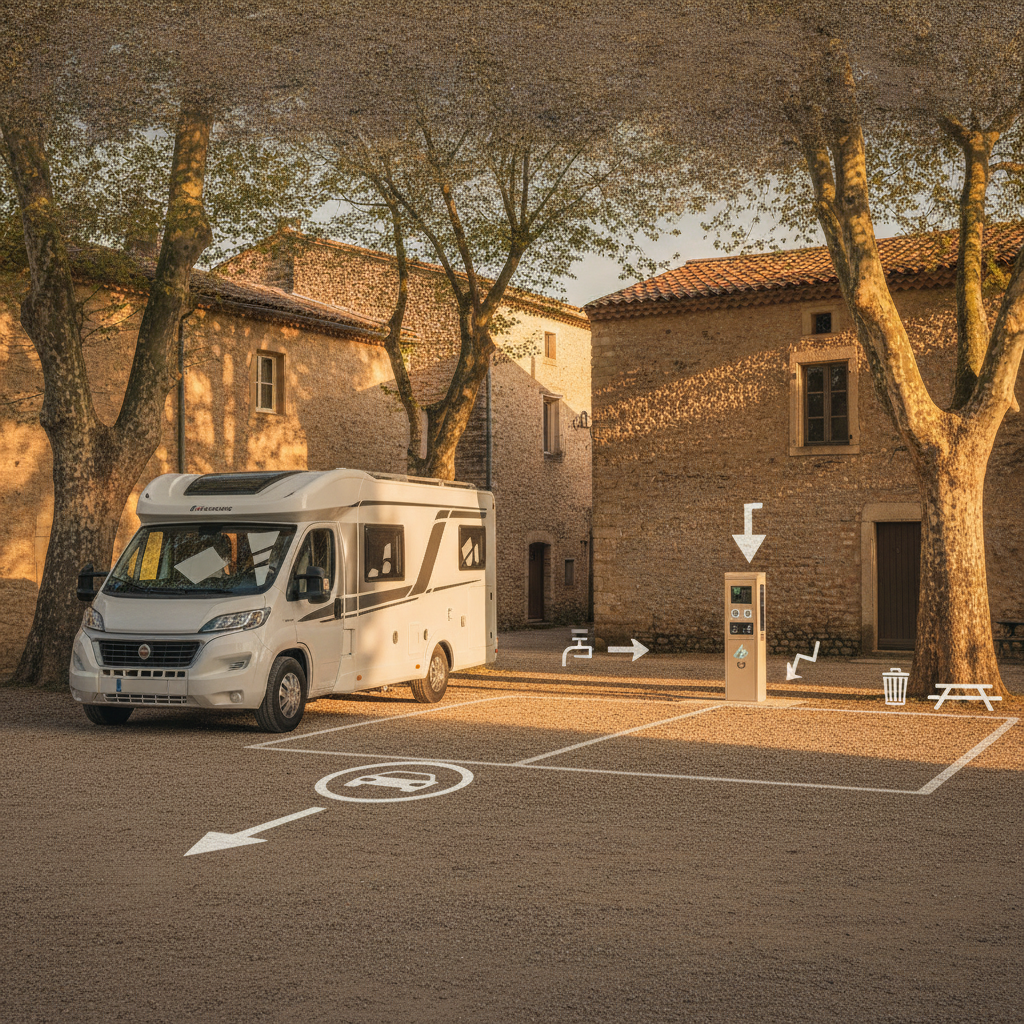
Some aires are little more than a marked section of a car park with a service point nearby. Others feel closer to a campsite, with individual pitches, electricity bollards, Wi-Fi and even a barrier on the entrance. The range is enormous, which is exactly why it pays to research before you arrive.
Are aires in France free?
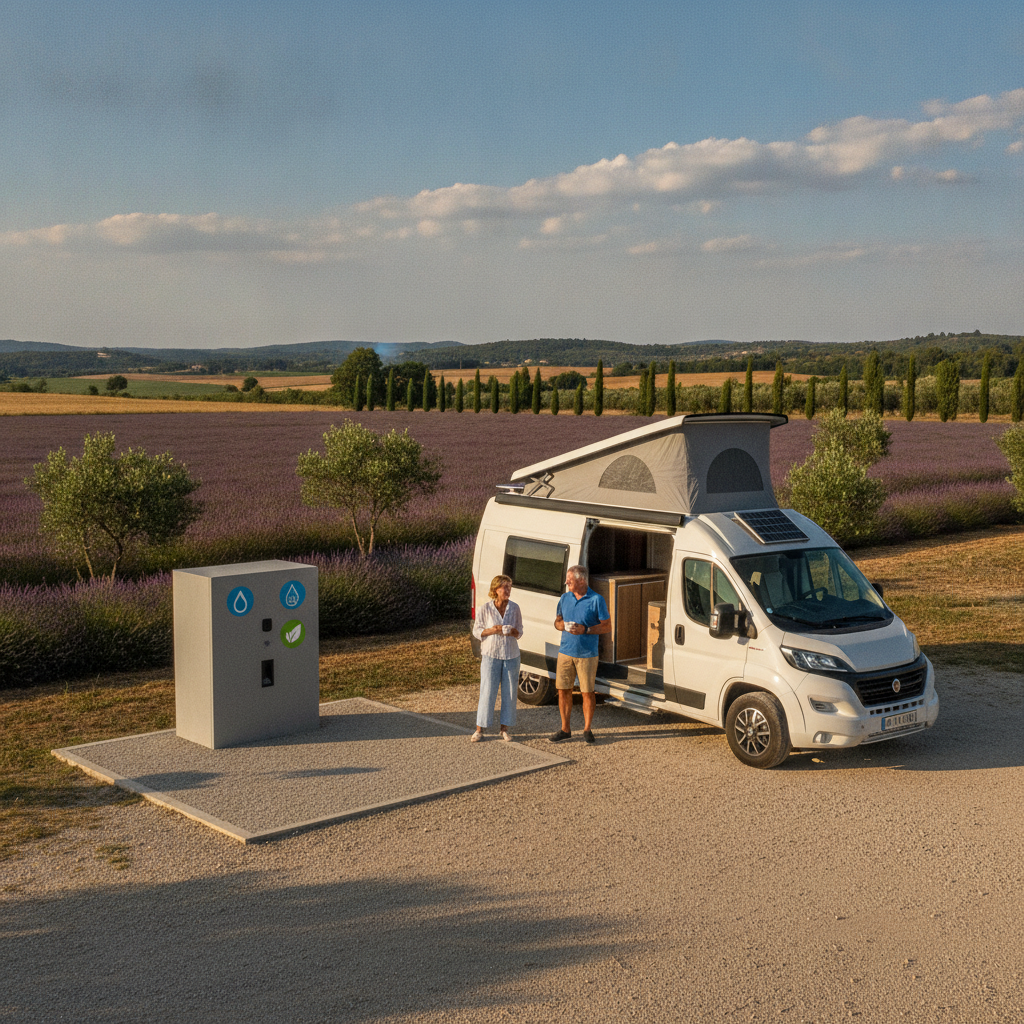
Some are, and some aren't. Free aires do exist in good numbers, particularly in smaller inland villages and rural areas where the council wants to attract visitors. At a free aire you'll typically get a legal overnight parking space, and there may be a service point nearby for emptying your cassette and refilling fresh water, though that service point often costs a euro or two to use even when parking itself is free.
Paid aires are increasingly common, especially in popular coastal and tourist areas. Prices vary widely. A quiet village aire in the Dordogne might charge €5 or €6 a night. A seafront pitch in Brittany or on the Atlantic coast during summer can be €15 to €20 or more, sometimes with an additional charge per kilowatt hour of electricity. That's still usually cheaper than a campsite, and the informality suits many motorhomers.
Payment methods have modernised considerably. Many aires now use dedicated machines that accept card or contactless payment. Older sites may still run on jeton (token) systems where you buy a token from a nearby tabac or tourist office to operate the service point taps and electricity supply. It's worth carrying a few euros in coins regardless.
What services can you expect at a French aire?
Services vary enormously, so it helps to know what you're looking at before you pull in.
- Parking bays: Almost all aires have marked bays sized for motorhomes, typically 8 metres long. Some use Flot Bleu, Urba Flux or similar branded service units.
- Fresh water: Most aires have a fresh water tap, though it may operate on a token or card.
- Grey water disposal: A drain for emptying your grey water tank, usually alongside the fresh water point.
- Cassette emptying (vidange): A dedicated cassette toilet emptying point. Not every aire has one; some direct you to a separate service point a short distance away.
- Electricity (EHU): Available at higher-end or paid aires, usually 6 to 10 amps via a bollard.
- Wi-Fi: Common at municipal paid aires, hit-and-miss at free ones.
Free-only service points, sometimes called aires de service, are dotted along roadsides and outside supermarkets across France. They're not for overnight stays; they're just for topping up water and emptying waste while you're on the move. Don't mistake one for an overnight aire.
Types of French Aire at a Glance
How do you find aires in France?
The simplest approach is to plan your route in advance using a dedicated resource. Campercation's France aires listings are part of a searchable map of 19,350+ stopovers across the UK and Europe (as at 20 September 2026), covering overnight parking, waste disposal points, water, LPG and fuel in one place. You can filter by service type, so if you need electricity for a night or you're running low on fresh water, you can find exactly the right stop without guessing.
Printed guides like the Guide Officiel Aires de Camping-Cars (published annually by Espaces Loisirs) remain popular and are thorough, though prices and facilities can change between editions. Apps such as Park4Night and Campercontact are widely used, with community-submitted reviews that give a realistic picture of what a site is actually like on the ground, including whether the service point is working.
Road signs are your friend too. Brown tourist signs in France often point to the aire de camping-car at the entrance to a town. If you're driving through a village and want to check whether there's an aire, look for the motorhome-and-tent symbol on a blue or brown background.
What are the rules for using aires in France?
French law permits motorhomes to park on public roads subject to the same rules as any vehicle, but overnight stays on the roadside are a grey area that varies by commune. Aires sidestep that uncertainty entirely because you're in a designated, legal space.
The main rules to follow at an aire are straightforward. Stay within the marked bays and don't block service points. Observe the maximum stay posted at the entrance, usually 24 or 48 hours; some tourist areas enforce this strictly in summer. Keep noise down after 10 pm. Don't put out awnings or chairs if the site rules prohibit it (some municipal aires explicitly ban this to maintain the "parking" status rather than "camping"). Take all your rubbish with you or use the bins provided.
Caravans and tents are not permitted at aires de camping-car. The pitch sizes and the legal designation are specific to motorhomes and campervans. Trying to stay in a caravan at an aire will likely result in being asked to leave.
Are aires the same as French campsites?
Not at all. French campsites (campings) are licensed facilities with pitches for tents, caravans and motorhomes. They typically offer showers, toilets, a reception and often a swimming pool. They're regulated under a star rating system and charge accordingly, often €20 to €40 or more per night in high season.
Aires are lighter-touch stops with no or minimal staffing. There's no reception, usually no showers or toilets on site (though some better-equipped paid aires do have them), and the atmosphere is informal. Many motorhomers use a mix of both: aires for shorter nights en route, campsites for a base when they want a longer stay with full amenities.
If you're planning a longer trip through France, browse the Campercation France aires map to build your route around verified stops rather than arriving somewhere and hoping for the best. Knowing your overnight spots in advance makes the whole trip more relaxed.
Can you wild camp in France instead of using an aire?
Wild camping, known as camping sauvage, is technically legal in France on land where it's not explicitly prohibited, as long as you have the landowner's permission. In practice, that's quite restrictive. National parks, beaches, forests managed by the ONF (Office National des Forêts) and many coastal areas prohibit it outright. Getting permission from a private landowner requires either speaking French or some confidence at the farmhouse door.
For most motorhomers, aires are the practical alternative. They give you the freedom and informality of stopping where you choose without the legal uncertainty of wild camping. And with thousands of them spread across the country, France is genuinely one of the best countries in Europe to tour by motorhome.
Ready to plan your route through France? Search verified aires, service points and overnight stops using the Campercation France aires finder, part of a live map of 19,350+ stopovers across the UK and Europe.
Frequently asked questions
What are aires in France?
Aires (short for aires de camping-car) are designated motorhome and campervan stopping places run by French municipalities, campsites or private owners. They range from a basic car park bay with a water and waste service point to more developed sites with electricity, Wi-Fi and individual pitches. They are legal, purpose-built stops specifically for motorhomes and campervans.
Are aires in France free?
Many aires in France are completely free, particularly in smaller rural villages. However, a growing number charge a nightly fee, typically €5 to €20 depending on the services provided. Even at free aires, using the service point for water or cassette emptying often costs a euro or two via a token or card machine.
How long can you stay at a French aire?
Most aires post a maximum stay of 24 to 48 hours at the entrance. Some tourist-area aires enforce this strictly during summer. Overstaying can result in a fine from local police (gendarmerie). Always check the sign when you arrive, and move on within the posted limit.
What services do French aires provide?
Most aires provide at least a fresh water tap and a drain for grey water. The majority also have a cassette toilet emptying point (vidange). Paid aires often add electricity hook-ups, Wi-Fi, and occasionally showers or toilets. Free aires tend to offer parking only, with a service point nearby.
Can a caravan use a French aire?
No. Aires de camping-car are designated specifically for motorhomes and campervans. The pitches are sized for self-propelled vehicles and the legal classification excludes caravans and tents. Caravan users need a licensed French campsite (camping) instead.
How do I find aires in France before I travel?
Campercation's France aires listings are part of a searchable map of 19,350+ stopovers across the UK and Europe, filterable by service type including water, electricity and waste disposal. Printed guides like the Guide Officiel Aires de Camping-Cars and apps such as Park4Night are also widely used by motorhomers on the road.