Last reviewed: 9 November 2026
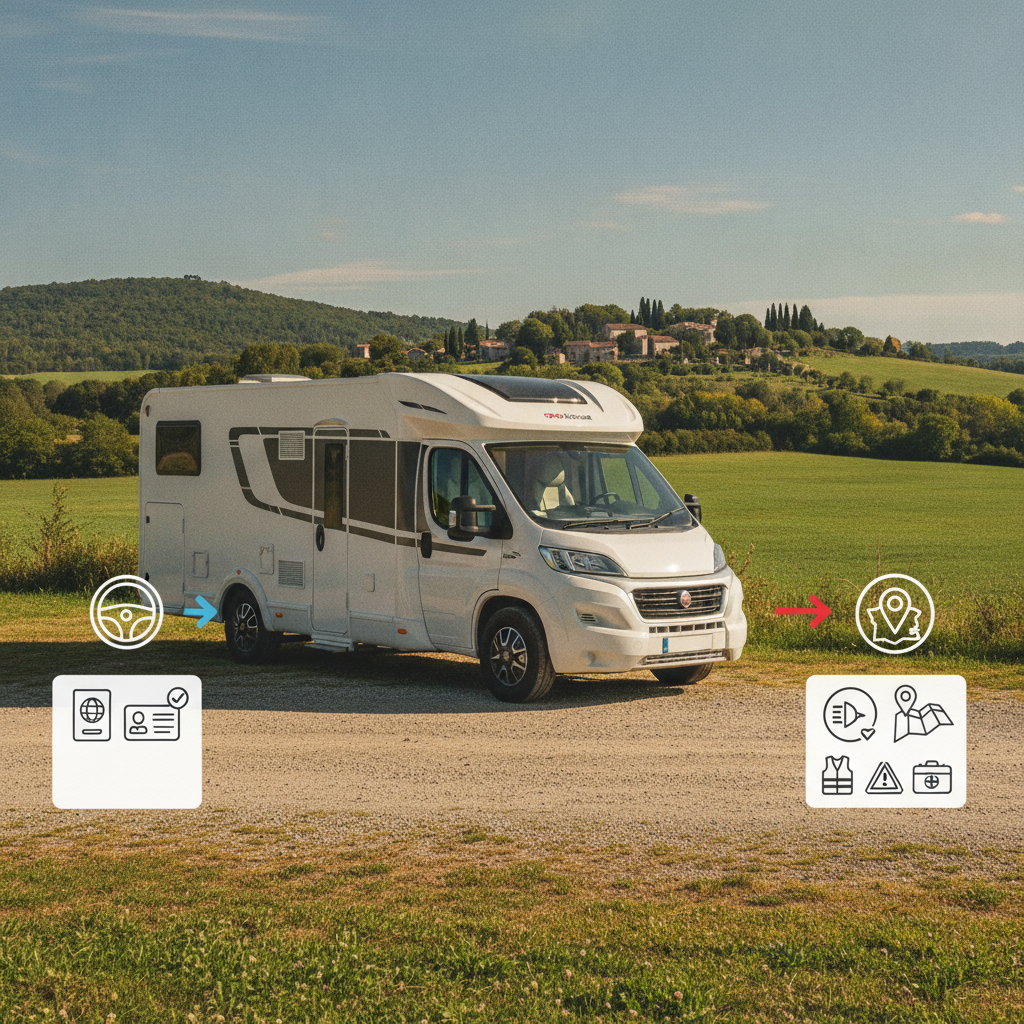
To drive a motorhome to France you need a valid UK driving licence, your vehicle registration document (V5C), valid insurance with at least third-party European cover, and a passport with at least six months' validity. You must also carry a warning triangle, high-visibility jackets for every occupant, a spare bulb kit, and a breathalyser. French low-emission zones require a Crit'Air vignette, so order yours before you travel.
Quick facts
- Passport must be valid for the duration of your stay, the six-month rule is a common guideline but verify current FCDO guidance before travel
- Crit'Air vignette costs around €3.70 and must be ordered from the official French government website
- UK motorhomes are limited to 110 km/h on French motorways (not 130 km/h like cars) if registered over 3,500 kg
- France operates a 90-day-in-180-day rule for UK passport holders, verify current status before travel
- Green Card (international motor insurance certificate) is not legally required in France but strongly recommended as proof of cover
- Campercation lists 19,350+ stopovers across the UK and Europe, including thousands of French aires, on one searchable map (as at 20 September 2026)
Which documents do I need to take?
Get these together before you even think about packing the awning. You need your valid UK driving licence, the vehicle's V5C registration document (or a letter of authorisation if the vehicle is on finance or hired), your passport, and your insurance certificate. If your insurer issues a Green Card, take it. France no longer legally requires one, but it's the clearest proof of cover you can hand to a gendarme at the roadside.
Your passport must be valid for the entire duration of your trip. The long-standing advice was to have six months' validity remaining, but that guidance has shifted since Brexit. Check the current FCDO travel advice at gov.uk shortly before you travel, because it does get updated.
If your motorhome is a hired or leased vehicle, carry a vehicle-on-hire certificate (VE103) instead of the V5C. Without it, French police can treat the vehicle as taken without consent.
What equipment does France require me to carry?
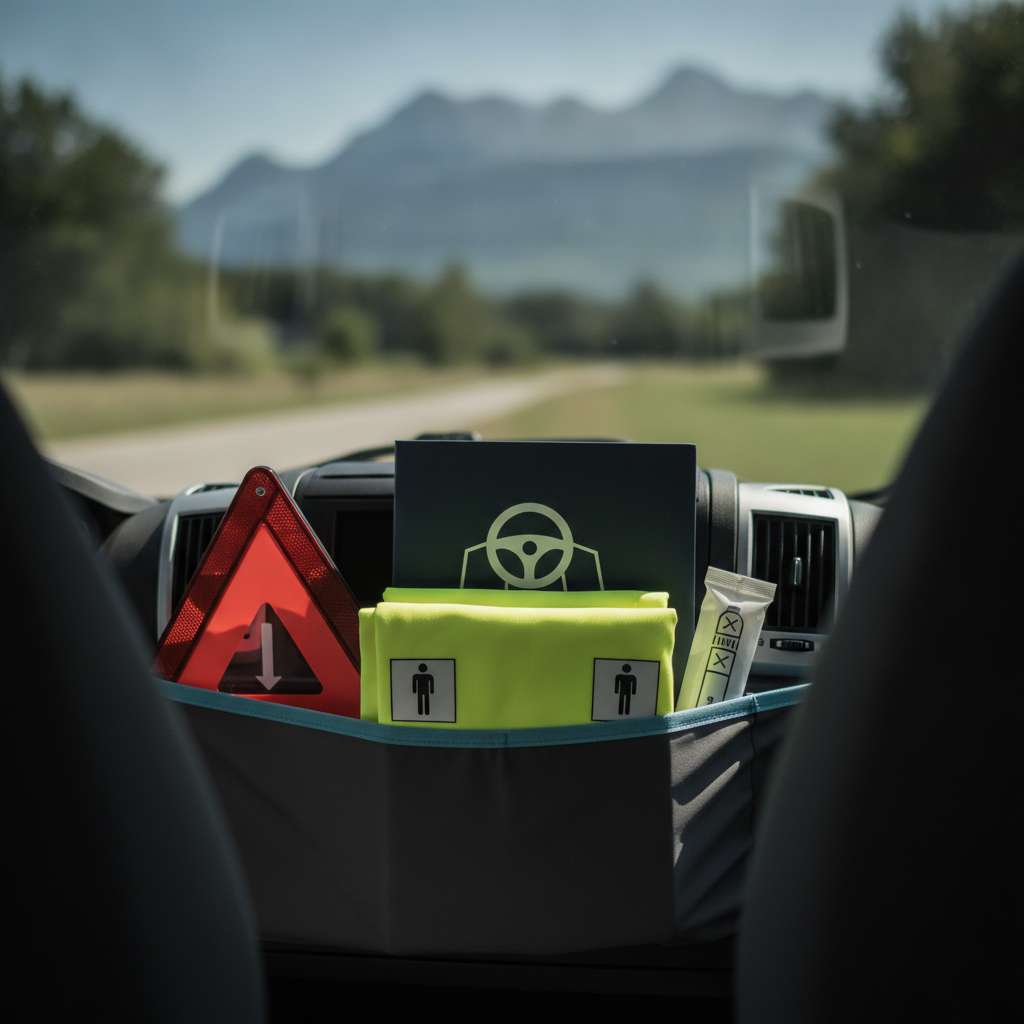
France has a mandatory kit list that catches a surprising number of UK visitors out. You must have all of the following in the vehicle:
- At least one warning triangle (placed 30 metres behind the vehicle in a breakdown)
- A high-visibility jacket for every person in the vehicle, stored where you can reach them without getting out first
- A spare bulb kit
- At least one single-use NF-approved breathalyser (the fine for not carrying one is currently a fixed penalty, though enforcement has been inconsistent, carry two to be safe)
- A fire extinguisher (not legally mandatory in private vehicles, but required for motorhomes used commercially; worth carrying regardless)
Headlights on UK vehicles dip to the right, which dazzles oncoming drivers in France. Fit beam deflectors before you board the ferry. They cost a few pounds at any motorists' retailer and take five minutes to apply.
Do I need a Crit'Air vignette for France?
Yes, if you plan to drive in or near any French city. France's Zones à Faibles Émissions (ZFE) cover Paris, Lyon, Grenoble, Strasbourg, Toulouse, Reims and several other cities, with more being added regularly. Without a Crit'Air vignette displayed on your windscreen, you can be fined for entering these zones.
Order your vignette only from the official French government site at certificat-air.gouv.fr. Copycat sites charge far more. The legitimate vignette costs around €3.70 and is posted to your home address, so order it at least two weeks before departure. You'll need to know your vehicle's Euro emission standard, which is on the V5C.
Most motorhomes registered after 2015 qualify for Crit'Air 2 or better. Older vehicles may be classified Crit'Air 3, 4 or 5, which restricts access to ZFE zones at certain times. Check the classification before you book your route.
Getting your Crit'Air vignette
What are the speed limits for motorhomes in France?
Speed limits in France differ by vehicle weight, and most UK motorhomers don't realise this until they see a speed camera letter arrive three weeks later.
- Motorways (autoroutes): 130 km/h for vehicles under 3,500 kg; 110 km/h for vehicles over 3,500 kg
- Dual carriageways: 110 km/h (under 3,500 kg); 100 km/h (over 3,500 kg)
- Single carriageways: 80 km/h for all, reduced to 70 km/h in wet weather for vehicles over 3,500 kg in some regions
- Built-up areas: 50 km/h, dropping to 30 km/h in many city centres
If your motorhome is over 3,500 kg MTPLM (maximum technically permissible laden mass, stated on your V5C), apply the lower limits throughout. When in doubt, assume you're over 3.5 tonnes, most coachbuilt motorhomes are.
How long can I stay in France as a UK citizen?
Since Brexit, UK passport holders are subject to the Schengen 90-day-in-180-day rule. This means you can spend a maximum of 90 days in the Schengen Area in any rolling 180-day period. France is a Schengen member. If you've recently toured Germany, Spain or any other Schengen country, those days count towards your 90-day allowance.
The practical limit for most motorhome holidays is well inside 90 days, so this rarely affects a single trip. But it matters a great deal if you winter in southern France or move between European countries over a long tour. The EU Entry/Exit System (EES) is due to be introduced, check the current FCDO guidance for the latest on border checks before every trip.
Where can I park overnight in France?
France has the best-developed aire network in Europe. Aires de camping-car are dedicated motorhome stopovers, often run by local communes, frequently free or under €10 a night. Many include water, grey waste disposal and even electric hook-up. Some of the most beautiful pitches in Provence, Brittany and the Dordogne are aires rather than campsites.
Wild camping (camping sauvage) is technically illegal without landowner permission in France, though enforcement is patchy in remote areas. Parking overnight in a motorhome on a public road is a grey area: it isn't camping, but some communes post local by-laws prohibiting it. Use an aire wherever possible.
Campercation lists 19,350+ stopovers across the UK and Europe on one searchable map, as at 20 September 2026, including hundreds of French aires with real user reviews, facilities details and GPS coordinates. Search French aires on Campercation and plan your route stop by stop before you leave home. You can filter by facilities, so if you need electric hook-up or a service point for grey waste, you'll find it in seconds.
What insurance do I need?
Your UK motorhome insurance must include at least third-party cover valid in France. Most UK policies include this automatically, but check the small print. Some policies only cover a limited number of days abroad (28 days is a common cap), so if you're planning a longer tour, call your insurer and extend it before you go.
Breakdown cover with European recovery is a separate purchase from most providers. This is not optional in a motorhome, a European tow and repatriation can cost thousands of pounds without it. The RAC, AA and specialist motorhome insurers all offer European breakdown cover. Buy it and keep the emergency number saved on your phone.
And don't forget travel insurance for the occupants themselves. The European Health Insurance Card (EHIC) was replaced by the Global Health Insurance Card (GHIC) for UK residents. It gives access to French state healthcare but doesn't cover repatriation or cancelled trips.
Is there anything specific to motorhomes I should check at the port?
Eurotunnel and ferry operators measure vehicles by height and length. Book your motorhome's exact dimensions rather than estimating, overhang from a rear-mounted bike rack counts. Height limits on the tunnel are 1.85 metres for vehicles over 1.8 metres wide; most motorhomes travel by ferry instead.
Some operators require proof of insurance and vehicle documents at check-in. Have them in a folder, not buried in a drawer. Border Force and French customs can and do conduct spot checks. With the EES system coming into effect, biometric checks at the border are likely to become routine for UK passport holders, allow extra time and check the latest guidance at the port you're using.
Planning your stopovers in advance means you can focus on the drive, not the scramble for a spot at dusk. Browse the French aires map on Campercation to build your itinerary before you pack. With 19,350+ stopovers listed across the UK and Europe (as at 20 September 2026), there's rarely a reason to arrive somewhere without a plan.
Frequently asked questions
Do I need a Green Card to drive my motorhome in France?
France no longer legally requires a Green Card (international motor insurance certificate), but carrying one is strongly recommended. It's the clearest proof of valid insurance you can present to police at a roadside check. Ask your insurer to issue one before you travel; most will do so free of charge. Without it, proving cover in a foreign language is far harder if you're involved in an incident.
What is a Crit'Air vignette and do I need one for my motorhome?
A Crit'Air vignette is a colour-coded windscreen sticker that classifies your vehicle by its emission standard. It's required to enter France's low-emission zones (ZFE), which cover Paris, Lyon, Grenoble and several other cities. Order only from the official French government site at certificat-air.gouv.fr for around €3.70. Allow at least two weeks for postal delivery before your trip.
How long can I stay in France in my motorhome as a UK citizen?
UK passport holders are allowed up to 90 days in the Schengen Area in any rolling 180-day period. France is a Schengen member, so days spent in Germany, Spain or other Schengen countries count towards your total. Most motorhome holidays fall well within 90 days, but long-term tourers and those who winter in France must track their days carefully. Check current FCDO guidance before each trip.
What is the speed limit for a motorhome over 3.5 tonnes in France?
Motorhomes over 3,500 kg MTPLM are limited to 110 km/h on French motorways (not the 130 km/h limit for cars), 100 km/h on dual carriageways, and 80 km/h on single carriageways. In wet weather, some roads reduce the limit further. Check your V5C for your vehicle's MTPLM. When in doubt, most coachbuilt motorhomes exceed 3.5 tonnes when loaded.
Can I park my motorhome overnight in France outside a campsite?
France has an excellent network of aires de camping-car, dedicated motorhome stopovers run by local communes, often free or under €10 a night. Wild camping without landowner permission is technically illegal. Overnight parking on public roads is a grey area and varies by commune. Using a listed aire is always the safest and most practical option. Campercation lists hundreds of French aires with facilities and GPS coordinates.
Do I need beam deflectors on my motorhome for France?
Yes. UK vehicles dip their headlights to the left, which dazzles oncoming drivers in France where traffic drives on the right. Beam deflector stickers redirect the dip to the right and are legally required. They cost a few pounds at motorists' retailers or online and take minutes to apply. Remove them when you return to the UK. Driving in France at night without them risks a fine and, more importantly, a head-on collision.