
Last reviewed: 5 November 2026
Yes, you can empty a chemical toilet cassette into a normal domestic toilet in most cases, but only if the waste has been treated with a formaldehyde-free, biodegradable toilet chemical. Formaldehyde-based chemicals are harmful to the sewage system's bacteria and must never go down a household toilet or any drain. The safest and most reliable option is always a dedicated chemical disposal point (CDP), which is exactly what they're designed for.
Quick facts
- Formaldehyde-free, biodegradable chemicals: safe to empty into a domestic toilet connected to mains sewage
- Formaldehyde-based chemicals: must never be emptied into a domestic toilet, drain, or septic tank
- Septic tanks: even biodegradable chemicals can harm the bacterial balance, check with your tank supplier before emptying there
- It is illegal to empty chemical toilet waste onto public ground, into rivers, or into surface drains
- Dedicated chemical disposal points (CDPs) accept all types of cassette waste regardless of chemical used
- Campercation lists 19,350+ stopovers across the UK and Europe, including waste disposal points, on one searchable map (as at 20 September 2026)
What actually happens when you empty a chemical toilet into a household toilet?
Pour a cassette into a domestic loo and the waste travels straight into the mains sewage system, where it joins everything else heading to the water treatment works. If you've been using a modern, formaldehyde-free fluid such as Thetford Aqua Kem Green or similar biodegradable alternatives, the sewage system can handle this without any problem. The chemicals break down naturally, the sewage bacteria aren't harmed, and the water company processes the waste as normal.
But if the cassette contains older-style formaldehyde-based chemicals, those compounds kill the very bacteria that sewage treatment relies on. That's not a minor inconvenience, it actively disrupts the treatment process. Most water companies in the UK explicitly state in their published guidance that formaldehyde-based cassette waste must not enter the sewage system via any route. Thames Water, Severn Trent and Wessex Water all publish this restriction. If you're unsure which company covers a property, the guidance is consistent: check the label of your toilet chemical before you empty anywhere.
So the first question to ask yourself before you even lift the cassette is: what chemical did I use, and does the packaging say formaldehyde-free?
Where can your cassette waste go?
Can you empty a chemical toilet into a septic tank system?
This is where you need to be more careful, even with biodegradable chemicals. A septic tank is a self-contained biological system. It relies on live bacteria to break down solids. Even chemicals marketed as biodegradable can suppress bacterial activity enough to slow or stall the digestion process inside the tank.
Some septic tank specialists and manufacturers advise against emptying any cassette waste into a septic system. Others say that occasional, diluted emptying of formaldehyde-free waste is tolerable. The honest answer is that there's no single universal rule, because tank size, bacteria load and usage frequency all affect the outcome.
If the property you're staying at uses a septic tank and you're not certain what type, don't empty your cassette there. Use a dedicated disposal point instead. It's the only approach that carries no risk to someone else's system.
Where can you empty a chemical toilet in the UK?
Dedicated chemical disposal points are the right answer every time, regardless of what chemical you've used. They're built for the job, connected to the right drainage, and you don't have to knock on anyone's door or explain yourself. Many motorhome service areas, aires-style stopovers, some pub stopovers and motorway service stations include a CDP.
Finding one when you need it is the practical challenge. Campercation lists 19,350+ stopovers across the UK and Europe as at 20 September 2026, including waste disposal points on a live searchable map. You can filter by facility type and find the nearest CDP to wherever you're parked. That's the quickest way to solve the problem without guesswork.
Search for waste disposal points near you on Campercation and you'll see exactly what each site offers, including whether it has a cassette hatch, a full motorhome waste drain, or both.
Is it legal to empty a chemical toilet in a public toilet?
Public toilets present a greyer area in practice, though the legal position is clearer. A public toilet is connected to the mains sewage system, so if you're using biodegradable chemicals, the sewage treatment argument holds. Some motorhome owners do empty cassettes in public conveniences and nothing bad happens.
But many local authorities object to this on grounds of hygiene and odour in a shared space, and some have put up notices prohibiting it. There's no single national law that explicitly bans it, but local bylaws can apply and you can be asked to leave or face a fixed penalty notice for causing a nuisance. Practically speaking, it's also unpleasant for other users.
The short version: it's not illegal per se with the right chemicals, but it's socially frowned upon and can fall foul of local rules. Use a CDP when you can.
How to dispose of chemical toilet waste properly, step by step
The process is straightforward once you know the right order of operations. Doing it correctly protects the environment, stays within the law and keeps things hygienic for you and everyone around you.
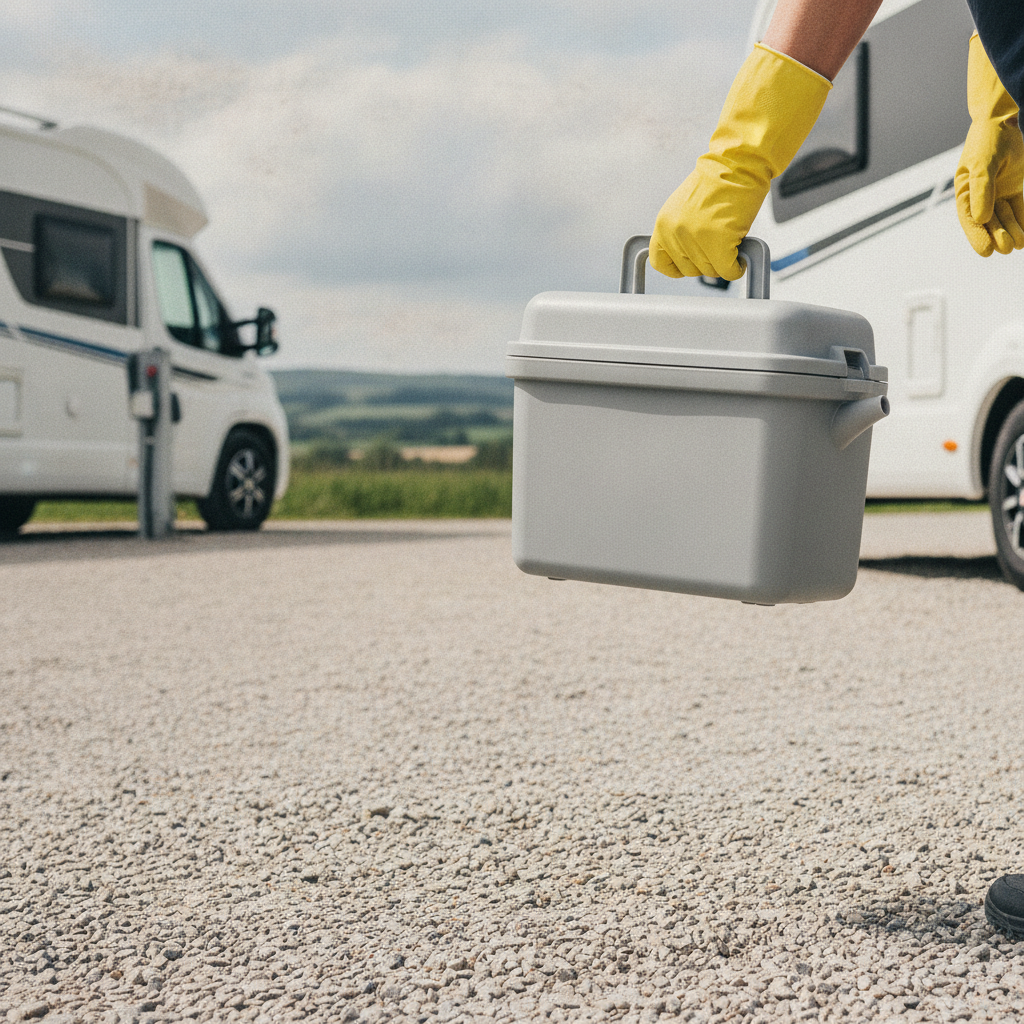
First, check your chemical. Formaldehyde-free and biodegradable? You have options. Formaldehyde-based or unknown? Go straight to a CDP, full stop. Second, locate a disposal point. Use the Campercation waste disposal map to find the nearest site. Third, wear disposable gloves. This is obvious but often skipped. Fourth, remove the cassette from its housing and carry it to the disposal point. Fifth, empty slowly to minimise splashing, then rinse the cassette thoroughly at the rinse point if one is provided. Sixth, add a small amount of fresh chemical and water before reinserting the cassette. That's the whole process.
What about emptying into a campsite or caravan park toilet block?
Purpose-built campsite and caravan park toilet blocks often include a dedicated cassette emptying point, usually a low-level sink or sluice clearly marked for the job. These are connected to the mains sewer and are exactly the right place to use. If you see one, use it in preference to the standard cubicles. It keeps things clean for everyone and means the waste goes where it's supposed to go. Not all sites have them, which is another reason to plan your emptying stops in advance rather than waiting until the cassette is full and your options are limited.
How often do you need to empty a motorhome chemical toilet cassette?
Most standard cassettes hold between 15 and 21 litres. For a couple, that typically means emptying every two to four days depending on usage. For solo travellers, you might stretch to five or six days. Don't wait until the cassette is completely full before you think about where to empty it. Carrying a brimming cassette is awkward and increases the risk of spillage. Plan your route around known disposal points, especially on longer trips or in rural areas where CDPs are more spread out.
Frequently asked questions
Can you empty a chemical toilet into a normal toilet?
Yes, if the waste has been treated with a formaldehyde-free, biodegradable chemical, emptying into a domestic toilet connected to mains sewage is generally acceptable. Formaldehyde-based chemicals must never go into any household toilet or drain. When in doubt, always use a dedicated chemical disposal point, which accepts all cassette waste regardless of chemical type.
Where can you empty a chemical toilet in the UK?
The best option is always a dedicated chemical disposal point (CDP). These are found at motorhome service areas, some pub stopovers, campsites and motorway services. Campercation lists 19,350+ stopovers across the UK and Europe as at 20 September 2026, including waste disposal points on a searchable map, so you can find the nearest CDP from wherever you're parked.
Is it illegal to empty a chemical toilet into a public toilet?
There is no single national law in the UK that explicitly bans emptying a cassette into a public toilet if you're using biodegradable chemicals. However, local bylaws can apply, and many local authorities prohibit it on hygiene grounds. You can be asked to leave or receive a fixed penalty notice for causing a nuisance. A dedicated disposal point is always the cleaner, safer choice.
Can you empty a chemical toilet into a septic tank?
Not without caution. Even biodegradable chemicals can suppress the live bacteria that a septic tank relies on to function. Formaldehyde-based chemicals must never go into a septic system. If you're unsure whether a property has a septic tank, do not empty your cassette there. Use a dedicated disposal point instead, and there's no risk to anyone's system.
How do I dispose of chemical toilet waste safely?
Wear gloves, check that your chemical is formaldehyde-free if using a domestic toilet, and always prefer a dedicated CDP when one is available. Never empty cassette waste into a surface drain, river, ditch, or onto open ground, this is illegal under the Environmental Protection Act 1990 and the Water Resources Act 1991. Rinse the cassette thoroughly after each empty.
Where to empty chemical toilet UK, what's the quickest way to find a point?
Use the Campercation waste disposal map, which covers dedicated disposal points across the UK and Europe as part of 19,350+ listed stopovers (as at 20 September 2026). Filter by waste disposal to find your nearest chemical disposal point in real time. Many motorhome service areas, pub stopovers and some petrol stations with motorhome facilities also offer CDPs.